Last updated by Don Kennedy at .
How Wood Rot Can Cause Termite Damage
Termites are nasty home invaders that have no interest in bothering humans. Their lives are completely separated from ours. They don’t need our food scraps, our bodies, or our pets but they do love wood rot. That’s the problem with termites- you never know they are in your home! You will find out quickly if you have bed bugs, ants, fleas, or cockroaches but termites may be feasting on your home unnoticed for years.
Video on Termite Damage and Wood Rot Repair
Extreme termite damage
We recently visited a home who scheduled a siding replacement but upon inspection it was found the home had wood rot and been a termite food fest for quite some time. The unnoticed nature of the infestation caused extensive repairs to be needed. The damage was so bad, termites began eating the foot of a wooden chair after they made their way through the subfloor!! Below we will explore (with pictures and video) the causes and extent of termite damage and how to repair.
Wood Rot Attracts Termites
Wood is rich in cellulose, the food source of termites. The attractiveness of the wood is increased by the presence of moisture which causes wood rot. Removing moisture away from your home- especially the foundation- can help you prevent termite problems. In the home we repaired, there was significant wood rot that attracted the termites which were caused by two major factors: 1.) The foundation was too close to the ground and 2.) The slope of the yard was not significant enough.
These two issues combined to cause excess water during storms to flow towards the house and soak the wood at the base of the wood. It was a perfect storm for wood rot and an all-you-can-eat buffet for the termites!
To Prevent Termites
Follow these basic steps to prevent wood rot and eliminate moisture from your home:
Even brick houses aren’t safe!
- Divert water from foundation
- Make sure gutters and drains are clean and work properly
- Repair any leaking pipes, faucets, or A/C units
- Seal any possible entry points for water around pipes and utility lines
- Remove potential food sources from around foundation (firewood, stumps, etc…)
Repairing Termite Damage
The first step to repairing termite damage is to remove the colony from your home. To do this, call a professional in your area. The job requires the use of many chemicals that should only be handled by those certified to do so. After the termite colony has successfully been exterminated, wood rot should be removed and replaced. In some cases, such as the video below, damage occurs on main support joists of the house. The wood on these cannot be removed due to the support they provide. An alternative in this case is to provide additional beams along the termite damaged wood to improve the strength of the support joists.
In the home we fixed multiple areas were affected by termite damage. Damaged wood had to be removed and replaced in the following places:
Stages of termite damage repair
- Band board (added rot and bug resistant PVC)
- Framing
- Main support joists
- Sub flooring
As you can see that is a very extensive repair, so keeping an eye out for termites is a good idea! Keeping reading to learn how to identify a termite infestation.
How to Spot Signs of Termites
If you may be worried you have termites, there are a few simple cues of an active termite colony. A quick survey of your property should be able to tell you if you have an infestation but as always, contact a professional to take a look if you aren’t sure. If you notice any of these issues, you may have termites:
- A swarm of winged insects in your home or in the soil surrounding your home
- Cracked or bubbling paint
Termite mud tubes- a sign of an active colony
- Termite droppings
- Hollow sounding wood
- Mud tubes (act as termite highways)
Treatment for Termites
I hope this post has shed some like on the silent home assassins. If you notice any of the warning signs in your home, contact a professional exterminator immediately to stop any further damage. If you have noticed any wood rot but have thankfully been saved from termites for now, then call a local home repair company like ProMaster at 513-724-0539. We can replace the wood rot and fix the cause so you keep your house dry and insect free! Thanks for reading. If you have any questions or comments about termites please share them with us below!
Call (513) 724-0539

Author Page
Window Repair vs. Window Replacement
Window repair vs. window replacement is a common debate that deserves a lot of attention. Window replacement is one of the most popular forms of home repair and remodeling. It is also rather expensive with costs averaging from $11,000 to $18,000 (~$400-$900 per window) in the Cincinnati area (Remodeling Magazine Cost vs. Value Report). Many window replacements are performed on windows with wood frames, which are common in older or upscale homes.
A better option may be to opt for a window repair at a fraction of the cost of a window replacement. Repair takes less time and is less intrusive to your home. If you are debating on window replacement in the near future, consider if a window repair will accomplish what you want. Most problems with old wood windows occur because of wood rot. Wood rot develops over time from exposure to the elements. The next paragraph will explore how to tell if you have repairable wood rot.
How to Identify Wood Rot
Look for wood rot in corner joints
Wood rot can occur in many parts of the home. The problem of wood rot is not confined to windows but they are at an increased risk. Wood rot is caused from the combination of increased moisture and heat. That’s why windows are so susceptible to wood rot. Windows must face rain, snow, ice, and direct sunlight every day of the year. The persistent exposure to the elements puts wood windows at higher risk for wood rot. The joints are a major problem area due to longer drying times.
If you notice excessive dampness, flaking or chipping, or visible fungal spores on the wood frame around the glass then that is a sign that your window is infested with wood rot causing fungi. These fungi can spread throughout your home and potentially cause health hazards. It is important to contact a professional if you notice any of these problems.
Close up of wood rot
How a Window Repair Will Save Money
If your window has noticeable wood rot but the glass and frame around the window are still in good condition consider a repair. A simple solution to window repair can be found by ordering manufacturer parts and replacing the areas affected by wood rot. After the wood rot affected areas are replaced with new wood, you can prime and paint the window to match the existing windows in your home. This can be done at a fraction of the cost of a window replacement.
Window repair is a great way to
- Save money
- Improve the look of your home
- Increase energy efficiency provided by a properly sealed window.
Watch the Video Below to See a Recent Window Repair by ProMaster Home Repair and Handyman of Cincinnati
Author Page
Do You Have Rotting Soffits or Fascia?
One of the most common home repair calls we get in the Cincinnati area are for soffit and fascia damage. Soffits and fascia are parts of the home that are particularly susceptible to water, storm and animal damage. Unfortunately, however, soffit and fascia construction defects abound in Cincinnati-area homes and therefore you need to be on guard to spot trouble before expensive soffit rot drains your bank account.
Watch Video on Soffit and Fascia Rot Explanation
How to Stop Damage to Soffits and Fascia
In this article and accompanying video, I will share with you how your soffits and fascia become rotted and ruined and what you can do to mitigate costly repairs resulting from their demise. Specifically, I will illustrate (using my high-tech white board!) how the roof, gutter, soffit and fascia work together to shed water from the house. Then I’ll indicate how a defect or breakdown in this system allows water to enter the fascia and soffit area to cause a rash of water damage and wood rot. Finally, I’ll share a few simple steps you can take to reduce your chances of experiencing costly fascia and soffit repair on your home.
How are Soffits and Fascia Damaged?
Soffit Rot in Cincinnati
First, a quick story. When I entered the home repair industry, I would look up toward the roof line of a home and notice that the soffits (sometimes called “eves” in other parts of the country) would appear damaged or worn. The paint would appear worn, bubbling or peeling and the wood would sometime be rotting. Ironically, the surrounding wood and paint on the fascia, trim and siding appeared fine. The soffit, being on the underside of the roofline, is generally sheltered from direct rain, ice and wind… so I thought, “Why would this area be damaged when surrounding areas are not?” My experience seems rather counter-intuitive, doesn’t it?
It wasn’t until I learned a little more about how the roof, gutter, soffit and fascia are supposed to work together that I uncovered the answer to my question. In the video associated with this article, I diagram how water gets in behind the soffit and damages the wood from the backside. The vertical surface of the soffit then traps moisture, allowing water to pool. Hence, wood rot and paint damage happen much faster as a result of the moist environment.
Fascia and Soffits Don’t Like Water
You really need to watch the video, as I’m much better at explaining things in person than in writing. But the overall concept of how water gets behind your fascia and soffit is fairly simple. Water flows down the shingles, reaches the end of the roof and needs somewhere to go. Ideally, the water falls off the shingle into a properly sloped gutter, into a downspout, out a drain and away from the house. However, some water will adhere to the underside of the shingle and drip down onto the fascia board.
Don Kennedy explains fascia and soffit rot
This is why a part called “drip edge” is critical to the process of protecting the fascia and soffit from water. Drip edge, does just what its name implies. It is a piece, usually made of aluminum, that runs parallel to the gutter and edge of the shingles to direct water away from the fascia and soffit and into the gutter. Think of drip edge as you would a crossing guard in front of a school. The children, then represent the wayward drops of water, wanting to run all over the place. The crossing guard makes sure that the kids stay in the crosswalk and protected from oncoming traffic. Drip edge, then, serves as the “crossing guard,” making sure water drops into the gutters and not allowed to soak the fascia or get into the soffit area.
Water Damage to Fascia and Soffits
Soffit Rotted Away
If the drip edge is broken or missing, damage to fascia and soffits can occur. Water coming off the roof will travel back up the shingle and soak the fascia board. Over time, the fascia board becomes rotted, undermining and of the fasteners that are sunk into that piece of wood. Given that the gutter is usually attached to the fascia board, during a heavy rain, the weight of the water in that gutter will cause either the gutter itself, or the entire gutter and fascia assembly to pull away from the home. In this case, homeowners might conclude that simply reattaching the gutter is all that is needed, when a much more comprehensive repair is required.
Once the fascia board rots or pulls away from the home, it opens up a perfect pathway for water to travel into the soffit area. As water pools inside the soffit, it completely rots and ruins that wood. Unfortunately however, unless a homeowner spot the water dripping out of a soffit vent, they won’t see any symptom until serious damage has occurred—that symptom being peeling paint or rotted wood. In such cases, no simple repair will do. Rather, the wood must be torn out and replaced.
Fascia and Gutter Pulling Away
Water entering the soffit region of the roof can also cause additional damage. If the leak is substantial enough, water can travel past the soffit into the exterior wall of the home and damage drywall, insulation, sheathing and framing. Moisture inside the wall not only causes expensive damage, but invites termites and carpenter ants to feed on the moist wood—perpetuating the problem. Repairing water damage from this scenario is invasive and expensive—yet often preventable.
Fascia and Soffit Warning Signs
Although your home may contain defects in how shingles, drip edge and gutters are installed, it may not be cost effective for you to inspect, remove and re-install these components correctly. Consequently, I’d recommend you keep an eye out for two things to alert you early on to a problem with your fascia.
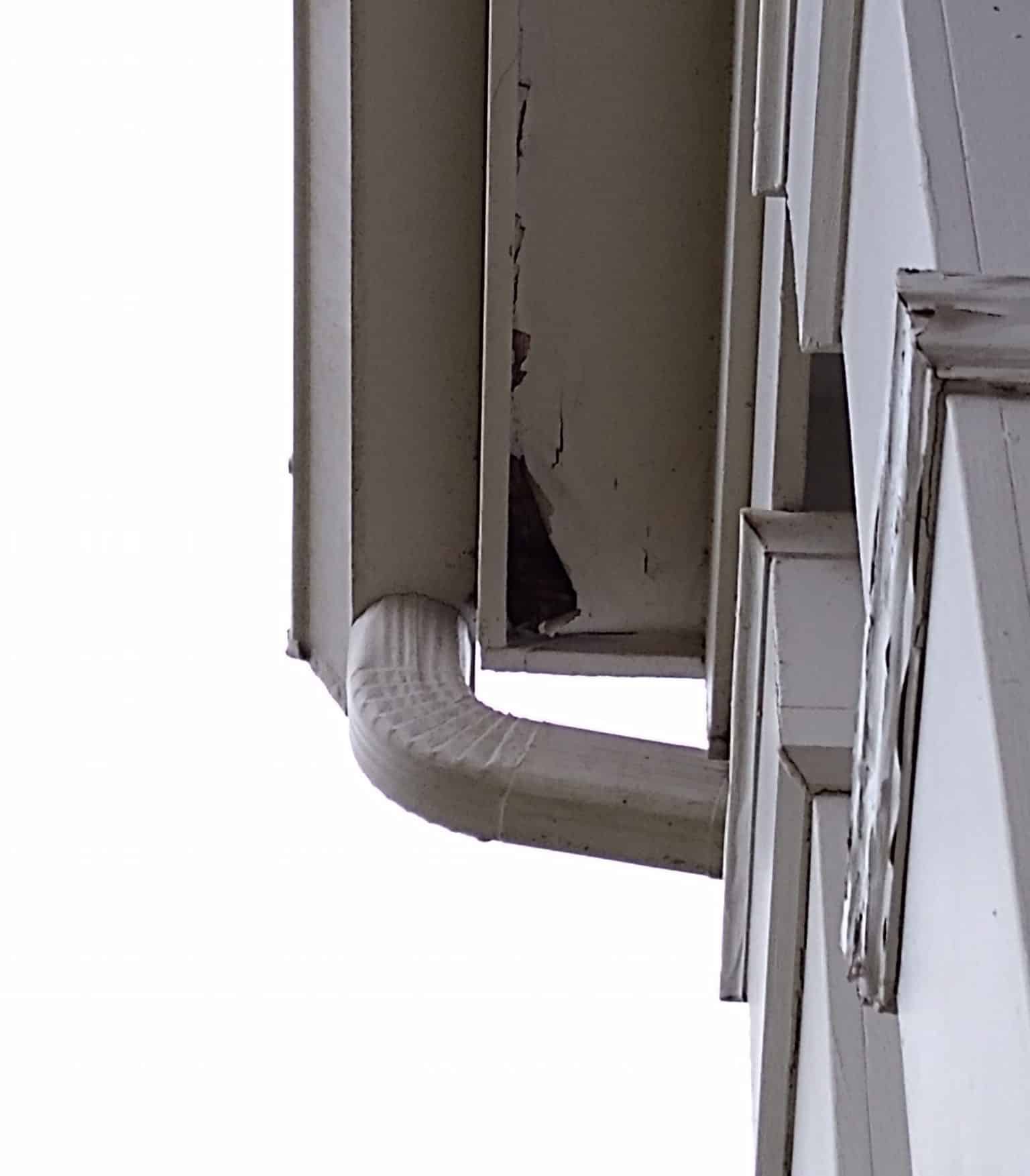
- Look for abnormality between the gutter and fascia: Discoloration peeling paint, dampness or deterioration in the fascia board can be resolved and repaired before damage to the soffit or wood rot occurs. (See accompanying picture)
- Look for stains or black streaks coming down the face of the gutter: This might be an indication of your gutters overflowing. Resolving this early before water backs up and flows into the fascia and soffits can save costly repairs in the future. (See accompanying picture)
Keep and eye out for fascia problems
Preventative Maintenance to Avoid Fascia and Soffit Repairs
- Keep those gutters clean! Often overlooked during a gutter cleaning are the qualities that keep the gutters flowing. Check the slope of all gutters along with cleaning the downspouts and drains. Gutter guards aren’t a fail-safe! Periodic inspection and cleaning is still needed if you have gutter guards installed.
- Keep wood fascia and soffits caulked and painted. If any water does come in contact with the wood, it will be protected from wood rot if the gaps are caulked and the paint is in good condition.
- Keep the animals & insects away! Birds, wasps, raccoons, squirrels and other critters seem to love this region of your home to make it theirs. Unfortunately, their presence is usually destructive to fascia and soffits so remove them as soon as they move in.
Gutters Are Key to Preventing Soffit and Fascia Damage
Call (513) 724-0539

Wood Rot Repair
You’re enjoying the beautiful weekend weather, working in your garden or entertaining guests, when you notice something unusual on the exterior of your home. Upon closer examination it appears that some of your wood soffits, trim, or siding doesn’t look as good as you remember it. You know that wood rot repair can be expensive. And just like cancer in the body, it must be dealt with quickly. But you aren’t sure if your wood rot repairs must happen now, or can wait a few months. Hopefully this video will help!
Wood Rot Can Almost Always Be Repaired
Every home, just like every person, is different. And when we become seriously ill, the range of treatment options can be expensive and immense, with no guarantee of success. But the good news with your home is that unlike people, it can almost always be repaired when seriously ill. Most homes in America are built with wood because it is cheap, plentiful and easy to work with when compared with other construction methods. In wetter parts of the country like Cincinnati, however, wood rot develops when construction defects, neglected maintenance or animal damage rear its ugly head.
Wood rot can develop unnoticed until it causes extensive structural damage. The following pictures and video will help you spot a potential problem before expensive wood rot repairs are necessary. Before contacting a home repair company to address the wood rot, I recommend that every homeowner attempt to answer the following three questions. This information will assist your home repair professional in diagnosing and properly treating the cause of your wood rot.
Wood Rot Repair Pictures
Wood Rot on Ledger Board
Wood Rot from Window
Three Important Questions Before Beginning a Wood Rot Repair
- Is there any animal or insect intrusion? Animal damage, carpenter ants or termites responsible for damaging the wood must be eliminated before any wood rot repair begins. Contact a wildlife removal specialist or exterminator before hiring a home repair company to perform the wood rot repair.
- Can you feel or see any dampness? Water intrusion is often the primary cause of the wood rot. Any information you can provide to your wood rot repair professional as to the potential source of water is invaluable in properly diagnosing the cause of the wood rot.
- Is the wood rot cosmetic or structural? Cosmetic rot in trim, soffits, or siding is certainly unsightly, but does not necessarily pose any immediate concern to the safety of the home. Whereas wood rot in any structural framing like bandbaords, sill plates, deck structures, etc. can cause additional damage to the home and potentially jeopardize the safety of those living within.
Wood Rot Repairs – Before & After
Minimize the Cost of a Wood Rot Repair
To minimize the expense and hassle of a wood rot repair, act quickly on any sign of wood decay, damage or water intrusion. Wood rot is not one of those home repairs that one should procrastinate on, as the cost for the resulting damage will tend to rise exponentially with time. In addition, make sure your wood rot professional obeys the Three Golden Rules for Better Home Improvement.
Call (513) 724-0539